Following the Money: Stablecoins, Crime Tracking, and Public-Private Compliance
Blockchain money laundering, address blacklisting, fraud cases 2024-2025
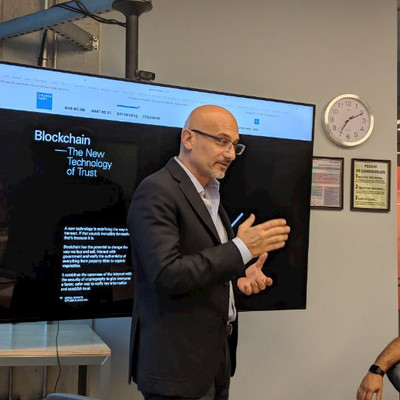
Full recording from 18/03/2026 at MERGE Stage. Also available on YouTube.
Hook: Tracking the Digital Crime Trail in the Stablecoin Era
Hook: In 2024-2025, $5.8 billion in stablecoins were involved in global fraud schemes, from "pig butchering" exploitation of vulnerable populations to sophisticated money laundering operations. The panel "Following the Money: Stablecoins in Financial Crime" brought together Brazilian Ministry of Justice investigators, prosecutors, and compliance operators to reveal how regulators use address blacklisting and fund freezing to halt illicit flows. Global 2024 success: Tether froze $23 million in the Garantex operation with U.S. Secret Service support.
5 Key Learning Points:
- Different Risk, Not Higher Risk: Stablecoins present a distinct risk profile compared to Bitcoin/Ethereum. They offer criminal advantages (lower volatility, stable value storage) but enforcement advantages (focal point for freezing, direct traceability). Source: Samuel do Nascimento Souza, Brazil Ministry of Justice 2024.
- Multichain Challenge: Loss of Linearity: Bridges and multiple blockchains create "investigation labyrinths." Sophisticated criminals use crosschain swaps, mixers, and bridges to obscure origins. Brazil's Cyberlab reports that criminals take "multiple steps" to evade tracing. Source: Samuel do Nascimento Souza, Cyberlab 2024-2025.
- Interinstitutional Cooperation as Key: On-chain tracing fails without agile public-private cooperation. Investigations require rapid channels with exchanges, wallet analysis, and log access. Without response velocity in minutes/seconds, funds disappear. Source: Ana Paula Bate, National Treasury Prosecutor Brazil 2024.
- Blacklisting as Weapon: Brazil USDT Case: In 2024 operation, ~460k USDT traced through multiple swaps and networks. Address added to USDT blacklist, preventing outbound movement (can receive but not withdraw). Criminal confirmed ownership via email, but funds remain frozen until sentencing. Source: Samuel do Nascimento Souza, Cyberlab 2024.
- Analytics Tools Evolution: TRM Labs, Crystal Intelligence, and blockchain analytics platforms now auto-track crosschain transactions. 2024 global volume: Tether froze 5,000 wallets with $2.5 billion total. Garantex (Russia) saw $23M frozen by Tether + U.S. Secret Service. Source: Lorenzo de Zopo, Corisma Solutions 2024.
5 Session Summary Subsections:
1. Nature of Risk: Different, Not Higher
Stablecoins create unique risk profiles. Unlike Bitcoin (pseudoanonymity, extreme volatility), they offer: rapid transaction speed, ability to freeze funds at focal points (centralized issuers), criminal preference for value stability. Criminals don't seek speculative risk; they seek "absence of risk" to transfer illicit value. Nascent regulation still allows "many opportunities" for effective blocking. Source: Ana Paula Bate, National Prosecutor Brazil 2024-2025.
2. Multichain Investigation: Psychological Challenge
Multiple blockchains and bridges create "loss of linearity" in investigations. Samuel do Nascimento Souza (Cyberlab) describes the scenario: Bitcoin → Ethereum rapid conversion → swap → crosschain bridge → mixer → return → another network. "This drives us crazy", he admits. Yet "when there's no way out, there's still a way": criminals leave traces (origin/destination wallets, conversion points). Interinstitutional cooperation is critical because investigations cross on-chain/off-chain boundaries. Source: Samuel do Nascimento Souza, Cyberlab 2024.
3. Public-Private Cooperation: The Time Factor
Lorenzo de Zopo (Corisma Solutions, 26 years in compliance) emphasizes: "Speed is everything." Private operators must: (1) Use correct monitoring tools (TRM Labs, Crystal Intelligence), (2) Report to authorities rapidly (minutes/seconds), (3) Be capable of stopping wallets at the right moment. Without this triad, funds vanish. Success of Garantex case 2024 ($23M frozen by Tether + U.S. Secret Service) proves "there's no point fighting": public-private collaboration = effective outcome. Source: Lorenzo de Zopo, Corisma Solutions 2024.
4. Pig Butchering and Fraud: The Vulnerable Side 2024-2025
"Pig butchering" fraud exploded in 2024: criminals seduce vulnerable people (elderly, limited financial literacy) on social media, convince them of fake "investments," take wallet control, send stablecoins to fake investment accounts, then vanish. $5.8 billion in stablecoins involved in such fraud 2024-2025. Cases include minors exploited for self-harm content paid in crypto (Cyberlab Brazil) and criminal financing of adolescents. Source: Samuel do Nascimento Souza, Cyberlab; Susana Camej, Ministry of Justice 2024.
5. Silk Road History and Modern Lessons
Silk Road creator (Bitcoin darknet marketplace 2010s) wasn't caught by blockchain tracing but by login from public library with username "Pirate Roberts." Lesson: crypto investigations require hybrid methodologies (blockchain + traditional methods). By 2024, transaction analysis became "like tax forms": modern tools create dashboards summarizing complex activity. Ana Paula Bate's analogy: "Multiple blockchains = parallel Brasília streets; at some point regulators must create accountability for logs, geolocation, compliance." Source: Ana Paula Bate, National Prosecutor; Susana Camej, Ministry of Justice 2024.
FAQ:
Q: How do centralized stablecoins freeze criminal funds if blockchain is decentralized?
A: Centralized stablecoin issuers (Tether, USDC) write "blacklist" functions in smart contracts. An address can be frozen by court order, preventing outbound movement (but allowing inbound). Brazil case 2024: ~460k USDT frozen after tracing multiple swaps. Limitation: only works if criminal didn't use DEX or mixers before converting to stablecoin. Source: Samuel do Nascimento Souza, Cyberlab 2024.
Q: What's the difference between investigating Bitcoin vs stablecoins in 2024-2025?
A: Bitcoin = total pseudoanonymity, extreme volatility, nearly impossible to "freeze." Stablecoins = centralized focal point (issuer), freezing capability, criminal preference for stability. Enforcement advantage: clear traceability to conversion point (where criminals necessarily expose themselves). Criminal advantage: speed, global liquidity. Source: Ana Paula Bate, National Prosecutor 2024.
Q: Is it viable to trace stablecoins across multiple blockchains (Ethereum, Tron, Solana)?
A: Difficult but possible. Challenge: "jurisdictional conflicts" (who owns log responsibility), identity change on bridges, data fragmentation. Tools like TRM Labs and Crystal Intelligence now auto-map crosschain transactions. Key: rapid cooperation with exchanges and stablecoin issuers. 2024 global case: Tether froze 5,000 wallets ($2.5B total) in regulator coordination. Source: Lorenzo de Zopo, Corisma Solutions 2024.
Q: What's the role of private compliance officers vs public regulation?
A: Compliance officers sit "in the middle," balancing authorities vs criminals. Critical 2024-2025 role: (1) Monitor transactions with correct tools, (2) Report rapidly to authorities, (3) Be capable of stopping wallets/transactions when court-ordered. Without this collaboration, investigations fail. Success example: Garantex 2024 ($23M frozen by Tether with U.S. Secret Service). Source: Lorenzo de Zopo, Corisma Solutions 2024.