Zero Gas Blockchains: Rethinking On-Chain Economics for Mass Adoption
Fixed fee, native tokens, decentralized payments, LATAM infrastructure
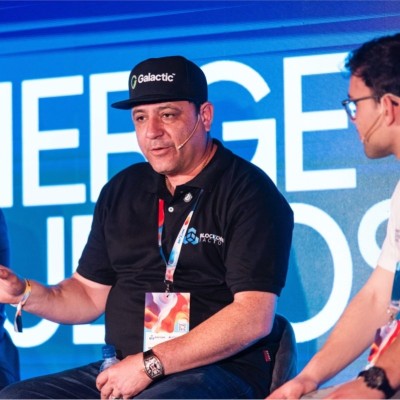
20min · Full recording from 19/03/2026 at MERGE Stage. Also available on YouTube.
Zero Gas Blockchains: Rethinking On-Chain Economics for Mass Adoption in LATAM
Hook: In 2024-2025, the most critical barrier to crypto mass adoption in Brazil and LATAM is not technology but transaction economics. While Bitcoin and Ethereum charge $0.50-$20 in gas fees, Maka Chain demonstrates that fixed $0.10 USD fees paid in the same token being sent are possible. This fundamental rethinking of on-chain economics eliminates friction that has stopped 100M+ potential users in LATAM from using crypto as fiat. Thomas Perez and Maka Chen team present how this architecture accelerates 10,000+ national stablecoins across Argentina, Bolivia and beyond.
5 Key Learning Points:
- Gas Fee Problem: Critical Mass Adoption Barrier: New crypto users face fundamental friction: receiving $100 USDT requires purchasing minimum $20 gas fee on Ethereum, making sub-$50 transfers economically unviable. This barrier decelerates adoption in LATAM where average transaction size is lower.
- Predictable Fixed Fee: $0.10 USD in Any Token: Maka Chain always charges $0.10 in the token you send (USDT, USDC, native Ethereum, or any token), enabling businesses and users to predict costs exactly. Critical for enterprises requiring certain operational margins, unlike dynamic gas that fluctuates 5-100x.
- 4,500 Transactions Per Second: Enterprise Scalability: Maka blockchain supports native 4,500 TPS, comparable to traditional payment networks like Visa, enabling LATAM enterprises to process real volumes without waiting for L1 Ethereum confirmations.
- EVM Bridges to Any Chain: Native Interoperability: Tokens on Ethereum, Polygon, or any EVM bridge automatically to Maka Chain maintaining 1:1 value, enabling fee arbitrage and access to fragmented liquidity in LATAM.
- Non-Custodial, Zero License: Decentralized Payment Model: Maka Pay functions as direct wallet-to-business smart contracts where Maka is never custodian, eliminating regulatory risks that paralyze crypto payments in LATAM. Zero currency or chain restrictions.
5 Session Summary Subsections:
UX Problem: Gas Fees vs. Fiat Transactions in LATAM
Thomas Perez illustrates core problem: new crypto user receives $100 USDT on Ethereum, wants to send to friend. Ethereum charges $0.78-$20 depending on congestion. User must purchase minimum $20 gas fee in MetaMask, making $100 transaction uneconomical. In LATAM where typical transactions are $10-$50, gas fees make crypto economically irrational. Source: Maka Chain UX analysis 2024-2025.
Fixed $0.10 Fee vs. Dynamic Gas: Enterprise Predictability
Maka Chain revolutionizes model: send USDT with fixed $0.10 fee in USDT. Send USDC with $0.10 in USDC. Merchant doesn't negotiate unknown gas spread. For LATAM commerce operating on 3-5% margins, $0.10 certainty enables correct pricing. Compared to Ethereum where gas can be $0.50-$50, Maka enables sub-$100 commerce volumes for first time. Source: Maka Chain business models, LATAM commerce analysis 2024-2025.
Adoption Partnerships: Argentina Stablecoins, 2,400 Exchanges, 6,000 Physical Locations
Maka Chain already operates with Estab and Entropia launching ARC (Argentina stablecoin). Fireblocks partnership provides access to 2,400 exchanges and wallets. Krypton network in Buenos Aires (6,000+ locations) enables crypto payments at physical establishments with predictable fees. This creates virtuous cycle: users receive ARC frictionlessly, merchants accept with clear margins, liquidity concentrates on Maka Chain. Source: Maka Chain partnerships 2024-2025.
Maka Pay: Decentralized Payment Gateway without Custodian or License
Payment architecture revolutionizes regulatory: direct wallet-to-business transaction via smart contract. Maka never touches funds. If user sends wrong token, one-click swap. If sent on wrong chain, one-click bridge. Merchant receives exactly what was requested. Zero regulatory licensing needed because transaction is peer-to-peer, non-custodial. This enables small LATAM merchants to accept crypto without MSB (Money Services Business) licensing burden. Source: Maka Pay architecture 2024-2025.
Use Cases: WordPress, POS, Deposit Address, Validators: Participatory Economy
Maka Pay offers 4 products: WordPress plugin (sites accept crypto), POS system (physical stores with tablet), deposit address (casinos), wallet-to-wallet (arbitrage). Each cashier gets unique link. Shopify coming Q2 2025. Additionally, Maka Chain operates 5,000 validator nodes with reward system. Users can run nodes, participate in security, earn commissions. This democratizes income: Maka Pay agent gets 0.75% of fee on every transaction, enabling participatory economy in LATAM where access to banking credit for startups is difficult. Source: Maka Pay models and validators 2024-2025.
Watch Full Panel:
Frequently Asked Questions (FAQ):
Q: Why is $0.10 a fixed fee if blockchain is decentralized and gas should vary?
R: Maka Chain captures gas variance through internal protocol design. It doesn't expose volatility to users. Model is similar to liquidity pools: protocol absorbs fluctuations through consensus design optimized for high-volume payment transactions vs. complex smart contracts. Source: Maka Chain technical architecture 2024.
Q: How does Maka make revenue if it charges only $0.10 per transaction?
R: Revenue model is mixed: Maka Pay charges 1% on each transaction (user pays $0.10, merchant pays additional 1%), Maka takes 0.25%, agents take 0.75%. Additionally, Maka Chain validators generate block reward income. Scale is key: projected $100B+ annual volumes in LATAM would make model viable. Source: Maka Chain revenue models 2024-2025.
Q: What happens if Argentina or LATAM regulates stablecoins in ways that prevent Maka Chain operation?
R: Regulation in Argentina 2024-2025 is favorable to stablecoins following economic crisis. BCBR in Brazil moves toward regulatory sandboxes. Maka is not custodian, it's protocol, allowing greater regulatory flexibility than traditional fintechs. If regulation is restrictive, Maka can operate in permissive jurisdictions and bridge to LATAM via exchanges. Source: Maka Chain LATAM regulatory analysis 2024-2025.
Q: What is the difference between Maka Chain and Lightning Network or Polygon for reducing gas fees?
R: Lightning is Bitcoin sidechain, limited to BTC. Polygon is Ethereum sidechain, requires bridging back to Ethereum with friction. Maka is native EVM-compatible blockchain with stablecoins as primary use case, with fixed fees and payment-optimized speed. Key difference: Maka doesn't require returning to L1 for liquidity. Source: Blockchain payment comparison 2024.